Indoor or outdoor? Indoor karting is available all year round, in town, on short, technical electric tracks. Outdoor is the real thing: powerful petrol karts, long sweeps, real weather and competition. The first to drive often without constraints, the second to make serious progress.
The question comes up a lot when you start, and the honest answer is that both have their place. It is not one against the other: they are two experiences serving different goals. Here is how to decide based on your profile.
What indoor karting has going for it
Drive all year, whatever the weather
The obvious advantage of indoor is the weather. Rain, wind, cold, heatwave: none of it matters. You get in the kart in the same conditions all year round.
More technical tracks than you would think
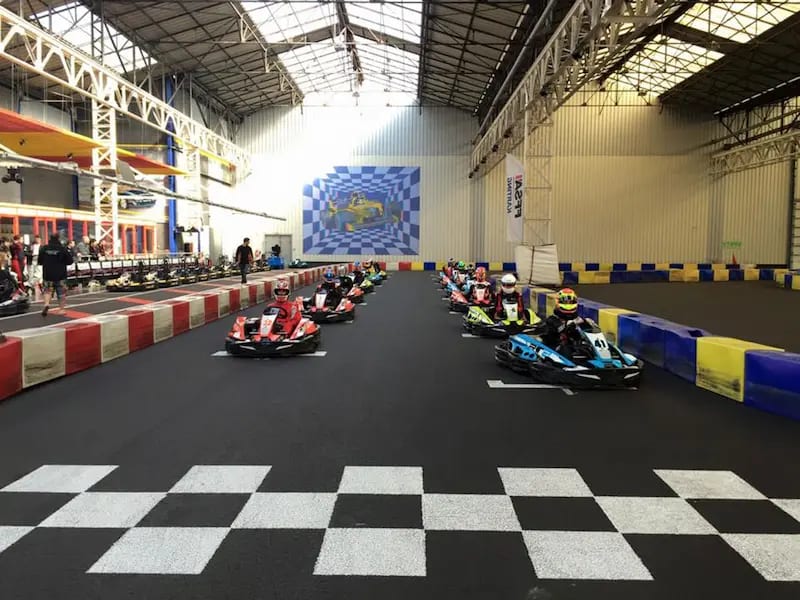
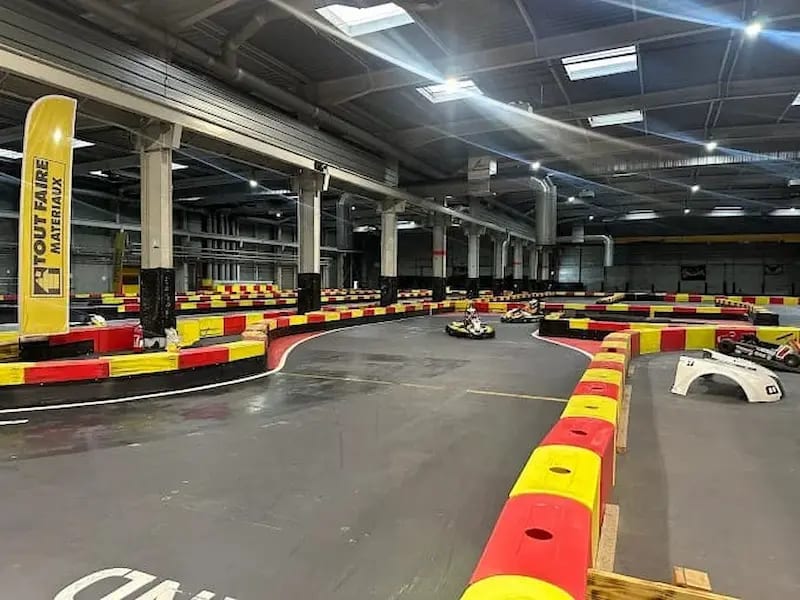
But it is not just that. Indoor circuits have made serious efforts to offer engaging layouts. The best ones have multi-level configurations, blind back corners and sequences that demand real driving. It is not just going round in circles. A circuit like Sélest'Kart-In, in Sélestat, is a good example of this modern indoor karting.
Electric, short, accessible
The karts are almost exclusively electric, which gives sharp, immediate responses. Sessions are short, 8 to 12 minutes, perfect for a quick outing or to string together several runs with brief recovery breaks. And above all, it is accessible: no car needed, often in town or on the near outskirts, open on weekdays. For driving regularly without complicated logistics, it is unbeatable.
What outdoor karting has going for it
A real track, real speeds
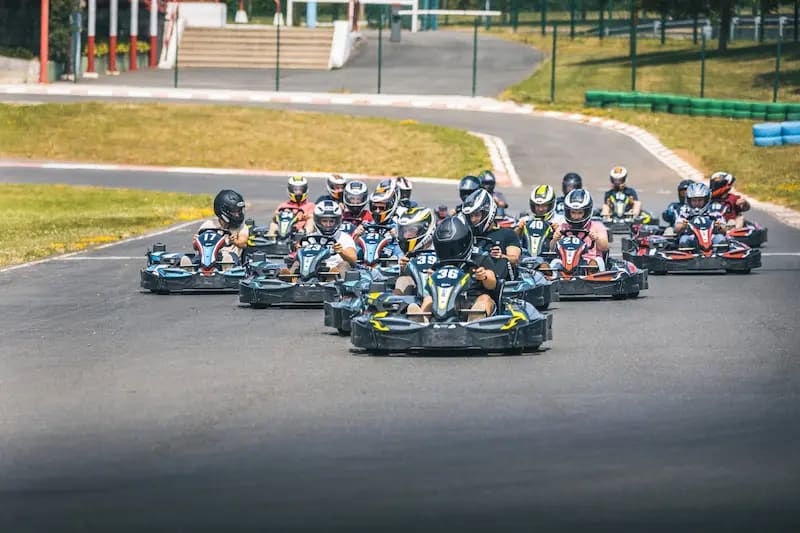
As soon as you get on an outdoor track, you understand what 'karting' means to serious drivers. Outdoor circuits are often between 700 metres and over a kilometre. The petrol karts, louder, more physical and more powerful, reach speeds that really make you feel the acceleration and braking. The karting de Nevers, at Magny-Cours, next to the Formula 1 circuit, gives an idea of the best of outdoor.
Weather as a teacher
The weather comes into play, and that is good news: a wet track completely changes the driving, and that is where you learn the most. Learning to feed the throttle in the wet only comes outdoors.
The home of competition
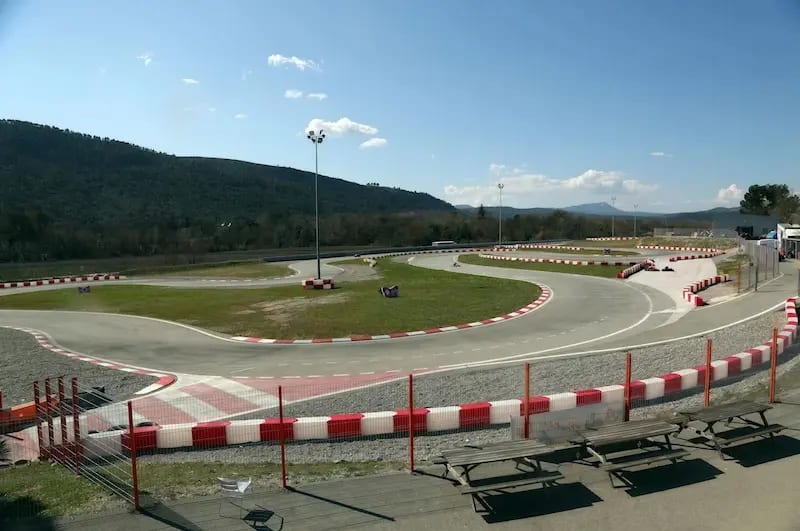
It is also outdoors that most karting competition takes place, from club level up to international. If you have racing ambitions, outdoor is the way through. The variety of layouts is greater there: slow hairpins, fast flat-out curves, long straights. Each circuit has its own personality, like Brignoles Karting Loisir, in the Var.
Indoor or outdoor: the comparison at a glance
| Criterion | Indoor | Outdoor |
|---|---|---|
| Weather | No influence, open all year | Depends on the weather (dry or wet track) |
| Engine | Electric karts, immediate response | Petrol karts, more powerful and physical |
| Track length | Often 250 to 600 m | Often 700 m to over a kilometre |
| Accessibility | In town, no car, on weekdays | Often out of the way, a planned outing |
| Formats | Leisure sessions (~10 min), sometimes grands prix | Sessions, sprint races, endurance up to 24 h, open practice |
| Best for | Driving often, leisure, events | Progressing, speed, competition |
How to choose based on your profile
For a spontaneous, accessible outing, no car or preparation needed: indoor. To make serious progress, explore driving in its richest dimensions and prepare for competition: outdoor. For a group event, team building or birthday, both work; indoor is often more practical logistically. And if you drive regularly, alternate: indoor to keep the rhythm during the week, outdoor for technical work at the weekend. Some venues, like Kart'IN Oberlin in Nancy, even offer both in one place.
The experienced drivers' trick
Many experienced drivers use indoor in a particular way: they work on precision there, not speed. On a tight circuit, every centimetre of line matters more than on a big outdoor layout. It forces a rigour that then shows everywhere. Conversely, outdoor develops high-speed reflexes, fatigue management and track reading over time. These are qualities you do not build indoors. The complete driver does not really choose: they use both.
Indoor or outdoor, every karting track in France and Europe is listed on Kart-Map. Filter by track type, compare and find the one that matches exactly what you are looking for.